
An AI pilot is not a workflow: build the weekly loop that improves the work
 Vicky Braxton·September 14, 2026·6 min read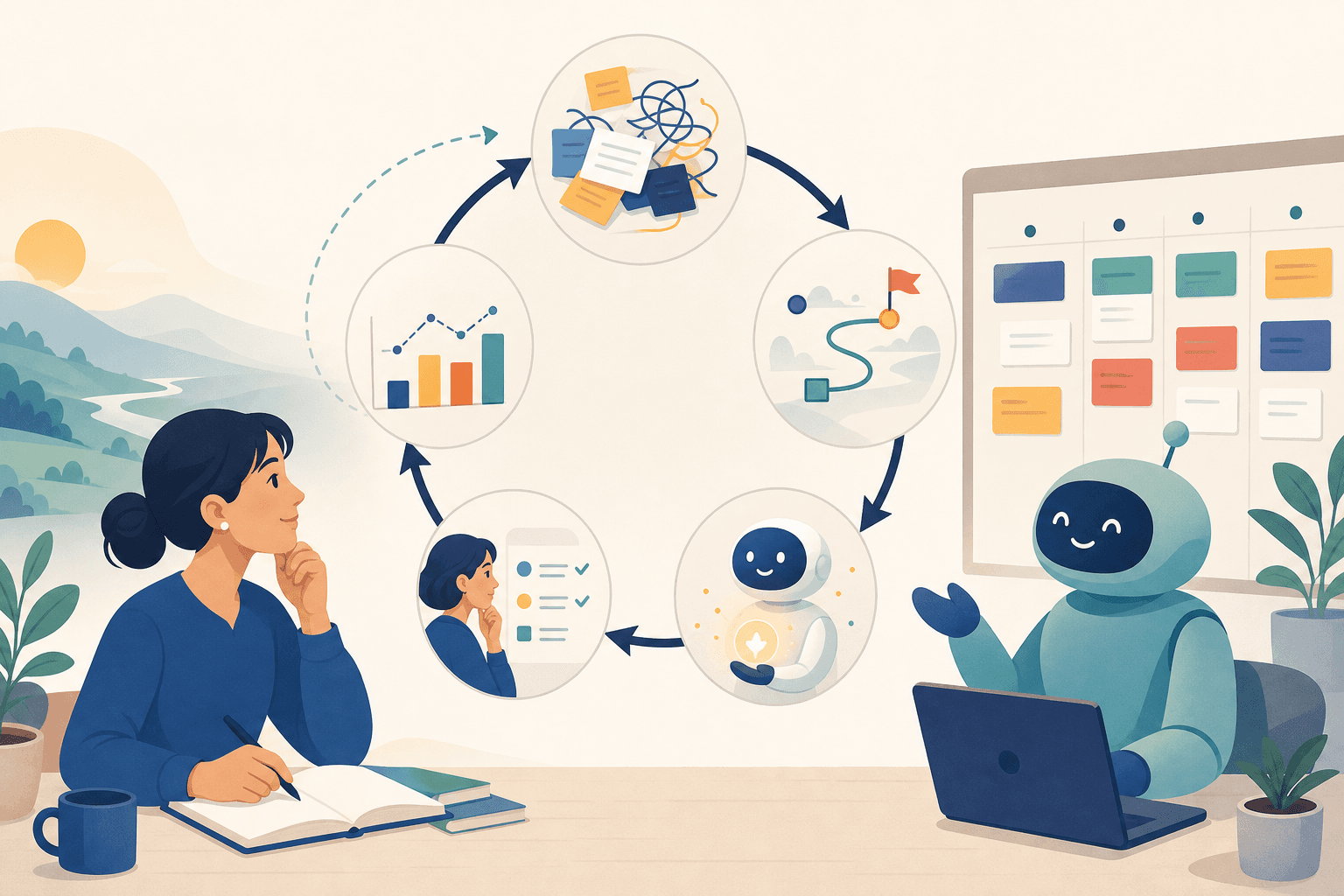
A demo can prove that an AI system can summarise a meeting. It cannot tell you whether the summary arrives before the next decision, whether anyone trusts it, or what happens when the notes are incomplete.
That is the difference between a pilot and a workflow.
A pilot asks, “Can the tool do this task?” A workflow asks, “What happens before, during, and after the task — and how will we know whether the whole chain is getting better?”
That second question is less glamorous. It is also where the useful gains tend to live.
The pilot answers the wrong question
Most AI experiments begin at the task level: draft an email, summarise a document, classify a support request, write some code. Those experiments are easy to show and easy to abandon.
Work, however, is usually a sequence of dependent tasks. Someone gathers the inputs. Someone checks whether they are complete. An AI system produces something. A person reviews it. Another person acts on it. An exception appears, and the neat process quietly turns into improvisation.
A 2026 MIT Sloan account of new research on AI and workflow design makes this point directly: AI’s value depends not only on what it can do, but on how tasks are sequenced, grouped, and handed off between people and machines.
There is useful evidence behind the broader warning. Microsoft’s 2026 Work Trend Index analysed anonymised Microsoft 365 productivity signals and surveyed 20,000 AI users across 10 countries. Its analysis found that organisational factors — including culture, manager support, and talent practices — accounted for twice the reported AI impact of individual effort alone.
That is a Microsoft analysis, not a universal law of physics. But it is a useful corrective. Better prompts and more enthusiastic employees will not repair a workflow with unclear ownership, missing inputs, or no definition of “done.”
Build a five-step learning loop
The practical answer is not a giant transformation programme. It is a small loop that makes one recurring piece of work visible, changes one part of it, and checks what happened.
1. Choose one recurring job and define “done”
Start with something that happens often enough to learn from. Good candidates include:
- a weekly sales or project update
- turning meeting notes into follow-up tasks
- preparing a customer-support summary
- creating a first draft from a standard brief
- checking invoices or documents for missing information
Do not begin with “automate reporting.” That is a category, not a job.
Begin with: “Every Tuesday, produce a three-part project update for the leadership meeting, with current status, risks, and next actions.”
Then define the finish line. Is the work done when a draft exists, when a human has checked it, or when the recipient can make a decision from it? Those are different outcomes.
2. Map the work as it actually happens
Do not map the ideal process described in a slide deck. Follow the real path, including the awkward bits:
- What starts the job?
- Where do the inputs come from?
- What is often missing or late?
- Where does judgement enter?
- Who checks the output?
- What happens when the result is wrong?
- What triggers the next handoff?
MIT Sloan’s work on dynamic work design uses a simple but powerful idea: make invisible work visible. Intellectual work is difficult to improve when it remains a vague cloud of messages, tabs, memory, and “I thought you had that.”
A basic board or one-page checklist is enough. The point is not to create bureaucracy. The point is to expose the handoffs and bottlenecks that the AI pilot would otherwise hide.
3. Give AI one job with a clear boundary
Avoid handing over an entire workflow with a vague instruction such as “manage this process.” Give the system a narrow responsibility:
“From the approved project notes, extract changes since last week, list unresolved risks, and draft the update in this template. Flag missing evidence. Do not invent status or send the update.”
That instruction defines the input, output, failure mode, and human checkpoint.
A useful first AI step is often one that reduces preparation rather than one that makes the final decision. Let it organise, compare, extract, classify, or draft. Keep the judgement that carries consequence with a named person until the workflow has earned more autonomy.
The same Microsoft report found that 86% of surveyed AI users treat AI output as a starting point rather than a final answer. That is not a weakness to hide. It is a sensible operating rule — provided the review is assigned to someone and does not exist only as a hopeful assumption.
4. Measure the whole chain, not just the AI step
“AI produced the draft in ten seconds” is not a useful result if the team then spends an hour correcting it.
For the first few cycles, track three simple signals:
- Speed: How long did the complete job take from trigger to usable result?
- Rework: How many edits, clarifications, or repeated handoffs were needed?
- Quality: Did the output contain missing, misleading, or unusable information?
Take a rough baseline before changing the process. Precision is nice; comparable observations are more important. You are trying to see whether the workflow improved, not win a laboratory award for stopwatch technique.
5. Review once a week and change one thing
Set aside 15–20 minutes after the job is complete. Ask:
- What became easier?
- Where did the process break?
- What did the human reviewer have to repair repeatedly?
- Which instruction, template, input, or handoff should change?
- What is the single experiment for next week?
Change one variable at a time where possible. If you replace the prompt, the template, the data source, and the approval rule together, you may get a better result but learn very little about why.
Record the decision. “Keep the extraction step; add a required source link to every risk” is more useful than “AI worked well this week.”
A concrete example
Suppose a small team prepares a weekly client update.
The current process is scattered across a project board, email, meeting notes, and a spreadsheet. The owner spends time finding changes, deciding what matters, writing the update, and chasing missing information.
The first experiment should not be “let an agent run client communications.” It should be:
- collect approved project notes and the previous update
- ask AI to identify changes, open risks, and missing inputs
- draft the update in a fixed structure
- require the owner to verify every claim
- record the time taken, corrections, and missing data
After three or four cycles, the team may discover that the biggest problem is not writing. It is that nobody records decisions in the same place. That is a workflow finding. The next improvement might be a required decision field, not a cleverer prompt.
The real advantage is accumulated learning
An AI assistant becomes more useful when it remembers the operating rules around the work: what “done” means, which sources are trusted, what errors recur, who owns the final check, and what changed last week.
Without that memory, every session is another isolated pilot. With it, the team can build a small, living system that improves through use.
So choose one recurring job. Make the invisible steps visible. Add one constrained AI action. Review the complete chain next week.
If you cannot say what changed, what improved, or what you will test next, you do not have a learning workflow yet. You have a demo with good manners.